Written by Valerie Larios
Edited by Nathan Aquino
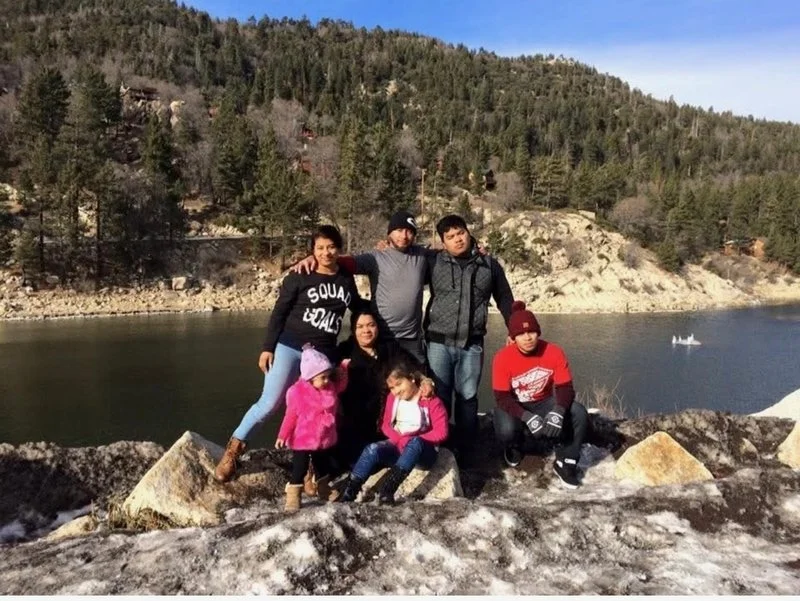
Guerrero’s family gathered together.
What if the person you expected to come home tonight never did?
For former South Gate student, Lia Guerrero, that question isn’t a hypothetical anymore. Her uncle was driving with his children in the car when he was pulled over and later deported, leaving his family behind in South Gate.
According to Guerrero, he had lived in the United States since before Guerrero was even born. For years, his life had been built here: his family, his memories, and the people who expected him to be there when they came home.
Then, in a matter of hours, that life was separated from the people he had built it with. To call that a deportation is true, but that isn’t the whole story.
Deportation is usually talked about through a political lens that makes it easy to forget there is a person at the center of it. We hear about immigration enforcement and arrests. We debate borders and laws. We argue about who should be allowed to stay, but somewhere underneath every statistic is a family that has to figure out what comes next.
This reality is especially close to South Gate.
The city is home to about 90,071 people, 95.2% of whom identify as Hispanic or Latino, according to the U.S. Census Bureau. About 41.9% of South Gate residents are foreign-born, and 82.5% of residents five years and older speak a language other than English at home.
Immigration is not some distant issue that belongs only to politics. In a community like ours, it is part of the lives of the people around us.
That makes the increase in immigration enforcement hard to ignore. In July, Immigration and Customs Enforcement (ICE) reported to the U.S. Census that they arrested 50,208 people.
The Transactional Records Access Clearinghouse, an independent research organization from Syracuse University that tracks data from government databases, reports that, in July, 70.6% of the current detainees had no criminal convictions.
At the beginning of September, The U.S. Department of Homeland Security reported that ICE arrested nearly 51,000 “illegal aliens” in August. This became the highest number of people arrested in a single month under President Donald J. Trump.
Fifty-one thousand is a big number. It’s also an easy number to read and move past until you put a face to it.
Guerrero’s uncle is one face behind the conversation. He is not a statistic in a report. He is someone’s father. He is Guerrero’s uncle. He is someone who had already spent years making a life in the same country where his children were sitting in the car beside him. But when he was deported, the consequences didn’t end with him leaving the country.
His family stayed.
Guerrero said her family was hesitant to tell her grandmother what had happened, knowing how much it would hurt her.
“Just seeing her cry broke me,” Guerrero said. She also remembered seeing her tío, who she said rarely shows emotion, become visibly affected by what happened. “I cried so much. I thought about it. I cried. I thought about my family, I cried.”
This is the part of immigration enforcement that deserves more attention. When someone is deported, the decision does not affect only the person being removed. It can leave children without a parent, families without a source of support, and homes missing someone who had always been there.
The government may record one deportation, but a family experiences a separation. I believe that is where our conversation about ICE needs to become more human.
A country can enforce its laws and still be held accountable for the consequences. We should be able to recognize that without turning human beings into political symbols.
It’s easy to talk about it when the person being talked about is faceless. It’s easy to say someone should be deported when we know nothing about their family, how long they have lived here, or what their absence will mean to the people waiting for them.
It becomes harder when that person has a name, when you know their children.
South Gate is filled with families whose stories are more complicated than a headline can explain. Some families have lived here for generations. Others have relatives who came here looking for a better life.
Some are citizens, some are immigrants, and some are families made up of both. Their experiences are different, but they share the same streets, schools and community. That is why we should care.
As students, it can be tempting to think of issues like immigration as something adults argue about or as just news we see on TV. Yet the people affected are right here in our own community. They are workers we see on our way home. They are parents who drop their children off at school. They are even the people sitting beside us in class. They are our neighbors.
Maybe that is the question we should be asking when we talk about immigration– not only who is allowed to stay or who is allowed to enter– but something simpler and much more painful:
Who gets to come home?