Written by Genesis Mora Edited by Nathan Aquino South Gate’s staff and students are navigating unexpected changes in the classroom following the recent displacement of two Individualized Education Program (IEP) personnel members, also known as Resource Specialist Teachers (RSTs).
The recent changes in RST staffing have resulted from the new contract agreed upon by LAUSD and various teacher unions, including United Teachers Los Angeles (UTLA).
According to UTLA, the new contract stipulates that “schools with 80% of Special Education students in a general education setting for 80% of the day will be capped at 20 students to one RST with one paraprofessional.”
South Gate High qualifies as one of these schools and must therefore adhere to the 20:1 ratio.
Despite the school administration’s efforts to advocate for retaining all of its RST staff, there are not enough current students to maintain the employment of all three of South Gate’s RST staff members.
This means they can no longer work at SGHS and must be moved to another school that meets the ratio requirements.
Initially, Jessica Baron, Isaac Gonzalez, and Francisco Ibarra were all displaced. However, despite having the seniority required to stay, Ibarra voluntarily accepted displacement so that Gonzalez, the next in line, could retain his position at South Gate.
Baron was able to remain at South Gate until mid-October, when another job opportunity opened up. She is now working elsewhere, and Ibarra is said to be at Maywood Academy.
Students and Staff Respond
Many students deeply appreciate these teachers and have formed meaningful connections with them. When this situation initially arose, students knew something had to be done.
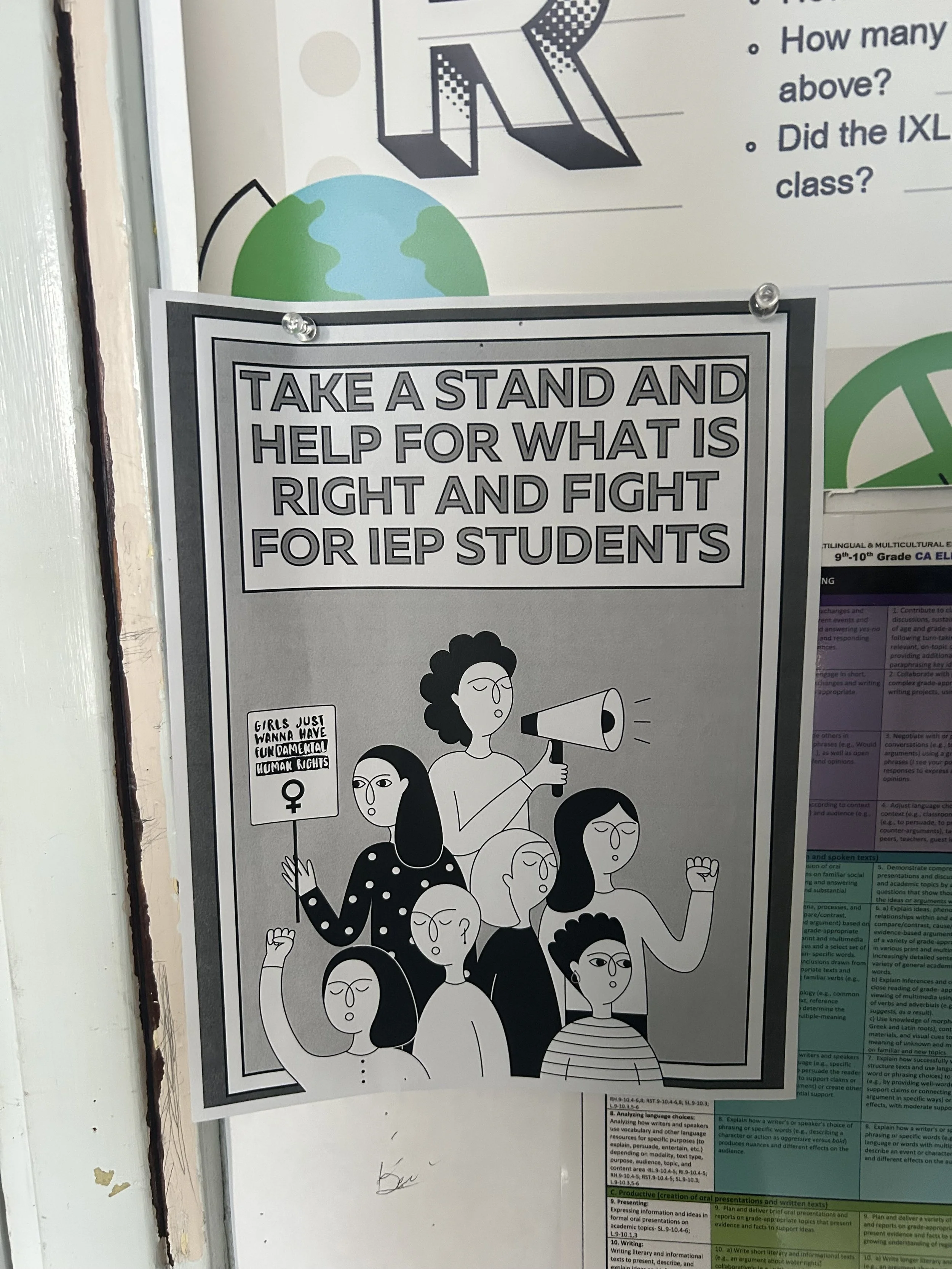
Student flyer posted in a teacher’s classroom.
Three South Gate students, 12th graders Ady Cortez and Natalia Aviles, along with 11th grader Michelle Martinez, organized a walkout to spread awareness among those who were unaware of the situation and to express concern about their education. They also created and posted flyers throughout the school hallways to spread the word about the movement.
On September 11th, 2026, approximately 25-30 students gathered on campus during fourth period to take a stand for their IEP teachers.
Students are not the only ones disturbed by these displacements. Other staff members feel their absence, especially during instructional time.
Science teacher Aaron Schroeder says, “I can’t go to everybody, as a teacher it will give me more work, and it's really frustrating sometimes because I have tons of kids asking for help and I can't get to all of them.”
This means that students’ needs are not being adequately met when there is only one teacher available. Many of the teachers agree that students will lose significant support, negatively affecting their learning.
Furthermore, Schroeder adds, “It's been difficult already, and it's gonna be really hard when we get to major labs like dissecting the frog because those are super hands on.”
When these teachers are removed from classes that need them, students lose a major source of support.
Before this situation arose, these teachers had worked comfortably in the same classrooms for years. Now, they must learn new subjects to accommodate the new classes they are assigned to.
Baron says, “that might not be as helpful for students because they are not having someone who can support their learning needs compared to somebody who already knows the content.”
Another consequence is that IEP teachers face “a higher caseload, meaning they have more students they have to support, and write their IEPs for. Which is not giving them enough time to balance being in the classroom supporting and writing those IEPs,” Schroeder explains.
What exactly is an IEP?
The Individualized Education Program is a plan that provides a student with specialized support based on their individual abilities and learning needs.
Often referred to as a student’s IEP plan, the program aims to provide students with learning differences– dyslexia, autism spectrum disorder, or ADHD– with specialized support from RSTs because traditional instruction does not fully address their needs.
Additionally, these teachers provide extra assistance in the classroom to all students, regardless of whether they have an IEP. For example, if a student without an IEP does not understand a lesson or has difficulty solving a problem, a Resource Specialist Teacher can sit down with the student and provide further explanations until the student understands.
IEPs are essential in a high school setting because students are preparing for their futures. Students who fall behind or need extra help can gain confidence in themselves by knowing that resources are available to support them.
Standing Up for Change
Despite the displacement of these teachers, the students' appreciation for them was so tremendous that their decision to participate in a protest for them left a positive impression on the teachers.
The students are passionate about their education and care very deeply about it. They took it upon themselves to seek answers and advocate for change.
Rather than the teachers protesting for themselves, students took the initiative to speak up on their behalf. This was unusual to some, and on the other hand, extraordinary.
“In general it's really hard to protest against something that you think is wrong or use your voice to stand up for what you think is right, advocate, etc.,” Baron said. “Adults struggle with that, and to be able to see a group of high school students do that–was really powerful and incredible.”